
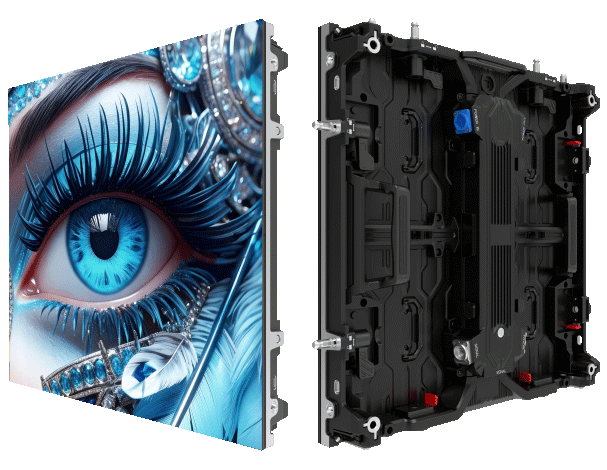
Comparative insight into a common technical challenge
Integrating disparate control ecosystems remains one of the more practical problems for production engineers specifying a large stage led display screen. This piece compares two dominant families of media processors and outlines architectures that keep timing, colour and mapping coherent across complex rigs. The emphasis is on what you must check and how to organise sending cards, receiver cards and scalers so that the final image is stable and predictable.
Core differences that matter
Novastar and Brompton take different approaches to signal flow and colour management. Key distinctions show up in how each handles EDID negotiation, frame rate locking and colour pipeline control. Novastar systems often rely on an ecosystem of sending cards and a control processor with vendor-specific calibration tools; Brompton emphasises processor-led scaling and a unified colour pipeline. Pixel pitch and refresh rate implications are straightforward: the control topology you pick affects mapping fidelity and frame synchronisation more than panel choice alone.
Practical architectures for mixed environments
Three pragmatic patterns emerge when both brands appear on the same show: a single-master architecture, dual-domain bridging, and hardware-level re-clocked distribution. Single-master routes all media through one processor type with the other acting as a passive receiver; dual-domain keeps two synchronized processors and uses genlock and timecode to align frames. A re-clocked distribution uses dedicated sync boxes and bufferised links to avoid timing drift. Each pattern requires attention to sync signal, mapping and scaler behaviour to prevent tearing and colour shifts.
Common pitfalls and rapid remedies
Interoperability failures usually come down to mismatched frame rates, conflicting EDID data or inconsistent calibration. Avoid cascading scalers without a clear master; incorrect EDID can force an unexpected resolution or framerate. A quick fix is to normalise the pipeline: set a single reference frame rate, export a LUT from the processor with the more capable colour pipeline, and apply it at the receiver stage. Manual mapping checks and a short black-level test pattern will reveal misalignment before load-in.
Case study — live touring scenarios and a venue anchor
Touring productions into large venues, such as Wembley Stadium or prominent West End theatres, often present mixed-vendor panels with differing receiver modules. In those contexts, teams standardise on one processor as the timing master and deploy external sync distribution to all receivers — this reduces latency variance across the array. That real-world constraint explains why many productions prefer to specify fine pitch indoor LED panels with uniform receiver compatibility: fewer variables at rig-up, faster test passes, and predictable calibration outcomes.
Operational checklist and best practices
Field-proven practice condenses into a short checklist: ensure a single reference clock, harmonise EDID tables, verify mapping with a test pattern, and perform colour calibration with the processor in situ. Keep an inventory of sending and receiver card firmware versions; differences in firmware often create subtle timing anomalies. A concise runbook for rig-up — power sequence, sync activation, then media playback — prevents costly reboots once the house lights are up.
Three golden evaluation metrics for selection
1. Timing coherence: measure end-to-end latency and frame-lock reliability under expected load. 2. Colour fidelity pipeline: confirm that a chosen processor can retain LUTs and black-level across the chain without forced re-sampling. 3. Operational friction: tally firmware variants, cable runs and required sync hardware — low friction means fewer failure modes in a live environment.
These three metrics translate to measurable outcomes on tour: fewer reboots, consistent colour between scenes and faster load-in times. They also point to why a considered control topology can be the decisive factor for a successful show — and why experienced specifiers turn to specialists who understand both hardware and on-site realities. MR LED. —
